MSI GeForce RTX 5070 Ti 16G Shadow 3X OC Gaming Graphics Card Buying Guide — Black Friday Deals 2026
Shopping for the MSI GeForce RTX 5070 Ti 16G Shadow 3X OC on Black Friday calls for more than a quick glance at the offer. Start with the parts of the listing that can be checked: memory, boost clock, interface, outputs, maximum display resolution, fan count and minimum power-supply requirement. Those details help establish whether the card belongs on your shortlist, but they do not settle questions the provided specifications cannot answer, such as performance in a particular game or how it will fit a particular case. During Black Friday, compare the exact model and variant shown in the offer, then weigh the listed facts against your own system and screen plans.
The Shadow 3X OC is listed with 16GB GDDR7 memory at 28Gbps on a 256-bit interface, a boost clock of 2482 MHz and a PCIe 5 interface. These are useful identifiers when comparing listings during Black Friday: check that the product name and the specifications correspond to this exact card rather than relying on a short title or image alone. The memory and clock figures describe the listed configuration; they are not, by themselves, a promise about frame rates, resolution-specific game performance or how the card will compare with another model.
This card may suit a shopper whose shortlist calls for the stated memory capacity and who wants to check those figures alongside a specific system plan. Its three-fan count, DisplayPort and HDMI outputs, and maximum display resolution of 4K UHD (3840×2160) give additional points to verify against intended use. The listing also states a minimum power supply of 750 W. That makes the system’s power supply an important pre-purchase check, but the available facts do not establish whether a particular computer meets every installation or operating requirement. For Black Friday, its most defensible editorial fit is shoppers comparing a card with these explicitly listed memory and display specifications—not shoppers assuming an unverified performance result.
Black Friday shortlist: read the memory and clock together
The listed 16GB GDDR7 (28Gbps/256-bit) memory specification gives shoppers a concrete configuration to compare. It can help distinguish this listing from another product whose title looks similar but whose memory details differ. The boost clock is listed as 2482 MHz, another useful identification point. Neither figure should be treated as a substitute for evidence about performance in a particular game, application or graphics setting; those outcomes are not established by the provided specifications.
When a Black Friday offer catches your eye, compare the complete model name and those memory and clock details with the product page you intend to buy. Keep the claims proportional: the figures describe the card, while your own software, settings and system are outside the facts available here. If your decision depends on a specific workload, seek information relevant to that workload rather than assuming the specifications answer it. This approach lets the numbers narrow a shortlist without turning them into an unsupported promise.
PCIe 5: verify the connection you plan to use
The card’s listed interface is PCIe 5. That is a useful point to check against the system you plan to use, particularly if interface details are part of your component selection. The specification identifies the card’s interface, but it does not establish the configuration of your motherboard or the behavior of a complete system. Do not treat the label alone as confirmation that a particular build is suitable; verify your own component details before committing to a purchase.
Black Friday listings can place similar-sounding product names side by side, so make sure the offer is for the Shadow 3X OC variant and not simply a card from the same broader product family. Compare the exact model identity and the PCIe 5 detail on the listing you are considering. This is a practical way to avoid choosing from a headline alone, without assuming anything about compatibility that the available facts do not state.
Plan the screen setup around listed outputs
DisplayPort and HDMI are the listed video outputs, and the maximum display resolution is 4K UHD (3840×2160). These details give you a starting point for comparing the card with the screens you intend to connect. Check the connections you actually need and compare them with the product listing; the provided information does not specify a count for either output or establish the capabilities of a particular monitor, cable or multi-screen arrangement.
The maximum resolution is a ceiling stated in the product facts, not a guarantee of a particular experience at that resolution. If your buying decision depends on how a game or application will run on a 4K UHD screen, that question requires evidence beyond the maximum-resolution listing. On Black Friday, keep these separate checks clear: confirm the outputs suit your planned connections, then assess any workload-specific expectations using appropriate information rather than reading performance into the resolution figure.
Make the power supply a decision checkpoint
The stated minimum power supply is 750 W. Treat that as a requirement to verify against the power supply in your planned system before buying. If you do not know the unit’s rating, check its documentation or label rather than guessing. The supplied facts do not describe the rest of your computer’s power needs or establish whether any particular power supply is suitable beyond the stated minimum, so avoid relying on this number as a complete system assessment.
This check matters whether the card is already on your shortlist or appears in a Black Friday offer that seems compelling. First confirm that the listing is for the exact model, then compare the stated minimum with your system’s documented power supply. If that information is unclear, resolve it before placing an order. A careful pause is more useful than treating a seasonal offer as a reason to skip a basic system check.
What three fans establish—and what they leave open
The product facts list three fans. That confirms the fan count, which can help you distinguish the card’s described design when comparing models. It does not establish noise, temperatures, cooling performance or the card’s dimensions, so those qualities should not be inferred from the count. If any of them affects your decision, look for reliable, model-specific information rather than treating three fans as an answer.
For Black Friday comparison, use the fan detail as one part of a broader checklist: exact variant, memory, interface, outputs, resolution and power requirement. The card may be worth further consideration if its listed configuration matches your priorities, but the fan count alone cannot show whether it is the right choice for your case or preferences. Keeping known specifications separate from open questions helps make the comparison useful without overstating what the listing establishes.
Key specs
Graphics memory
16GB GDDR7 (28Gbps/256-bit)
GPU clock
Boost: 2482 MHz
Interface
PCIe 5
Video outputs
DisplayPort, HDMI
Number of fans
3
Maximum display resolution
4K UHD (3840×2160)
Minimum power supply
A power supply with min. 750 W
Make your Black Friday choice
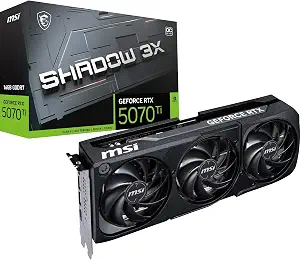
A sensible Black Friday decision starts with the exact MSI GeForce RTX 5070 Ti 16G Shadow 3X OC listing, not a broad product-family name or an assumed deal. Check the stated memory, boost clock, PCIe 5 interface, DisplayPort and HDMI outputs, maximum resolution, three-fan count and 750 W minimum against your priorities and system information. Then compare the exact offer and variant you are considering, without assuming a discount or a performance outcome from the season or the specifications. If key questions remain, resolve them before buying; a card that fits your documented requirements is a stronger shortlist choice than one selected on an unverified expectation.
 Check Price on Amazon