PNY NVIDIA GeForce RTX™ 5070 OC Triple Fan (ASIN B0G26Y3H2R)
PNY NVIDIA GeForce RTX™ 5070 OC Triple Fan Buying Guide — Black Friday Deals 2026
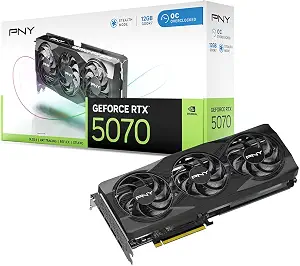
Choosing an RTX 5070 during Black Friday calls for more than comparing a headline or looking for a familiar model name. The PNY NVIDIA GeForce RTX™ 5070 OC Triple Fan has a specific set of listed details: 12GB GDDR7 memory, a 2587 MHz boost speed, a 192-bit memory bus, a PCIe® 5.0 interface, HDMI®/DP 2.1 outputs, 2.4-Slot thickness and Number of Fans 3. Those details help define what to check against your own priorities, but they do not answer every question about a graphics card or your system. Use this guide to separate the card’s stated features from the information you still need to confirm, and compare the exact Black Friday offer rather than assuming every RTX 5070 listing describes the same variant.
The PNY NVIDIA GeForce RTX™ 5070 OC Triple Fan is a single-card choice for shoppers who want the listed memory, interface and display-output details together in one product. Its 12GB GDDR7 memory and 192-bit memory bus are useful comparison points when you are deciding which specifications matter for your intended tasks. The listing also gives a Boost Speed of 2587 MHz. Treat that figure as a stated specification, not as a guarantee of how a particular application or game will run. Around Black Friday, keep the complete product name and these details beside the offer so a tempting headline does not distract from checking which card you are actually considering.
The physical and connection details can help focus your research before checkout. This card is listed with Number of Fans 3 and 2.4-Slot thickness, while its interface is PCIe® 5.0 and its video outputs are HDMI®/DP 2.1. Those are concrete identifiers to compare with your build notes and display plans, not a substitute for checking the information relevant to your particular setup. The “OC Triple Fan” name may appeal if that configuration is what you are seeking; it does not, by itself, establish a result in use. For Black Friday, the practical case for this model is that its listed specifications are clear enough to check one by one against your own requirements.
Black Friday: separate the model identity from the headline
A Black Friday offer can draw attention to the RTX 5070 name, but the exact variant matters when you are comparing listings. Here, the product is identified as the PNY NVIDIA GeForce RTX™ 5070 OC Triple Fan. Before judging an offer, match that complete name and the stated characteristics—12GB GDDR7, 192-bit memory bus, PCIe® 5.0 and Number of Fans 3—to the item shown in the listing. This is a way to avoid comparing different product descriptions as though they were interchangeable; it is not a claim that another variant is better or worse. If a listing does not make a detail you care about clear, seek clarification rather than filling in the gap yourself. Decide whether the exact card meets your priorities before considering the offer attractive.
Give memory capacity and bus width separate jobs
The listing identifies both 12GB GDDR7 memory and a 192-bit memory bus. Keep those as distinct comparison notes: they describe separate aspects of the card, and one figure should not be used as a substitute for the other. If you are comparing RTX 5070 options, record both alongside the exact model name, then consider whether each detail is relevant to the applications you plan to use. The provided specifications do not establish how a particular workload will perform, so avoid treating either number as a promise of an outcome. During Black Friday shopping, this distinction helps make your comparison more deliberate: prioritize the specifications that matter to your plans and avoid letting a single prominent figure make the decision for you.
Use boost speed as a specification, not a prediction
PNY lists a Boost Speed of 2587 MHz for this card. That is useful when you want to compare the stated specifications of products you are considering, but it does not tell you the result you will see in a particular game, application or system. Keep the figure in its proper role: a listed detail to verify, not a substitute for information about your intended use. If speed is important to your decision, compare the same kind of stated information across the exact models on your shortlist and look for details relevant to your own workload. Black Friday can make quick comparisons tempting; taking a moment to distinguish a specification from a performance guarantee helps keep the buying decision grounded in what is actually provided.
Check the interface and outputs against your plans
This PNY card lists a PCIe® 5.0 interface and HDMI®/DP 2.1 video outputs. Use those details as prompts for checking the connection requirements of your own system and display setup. The output description names HDMI and DP 2.1, but does not provide further port counts or a specific arrangement, so do not assume details that are not stated. Likewise, the interface listing alone does not settle every system-compatibility question. Consult the relevant documentation for the components you intend to use, and resolve any uncertainty before buying. For Black Friday, this step is especially useful when multiple listings look similar: compare the exact connection information you need, rather than relying only on the RTX 5070 label.
Plan around the listed 2.4-Slot thickness
The card’s stated thickness is 2.4-Slot. If you are choosing a card for an existing build, put that precise figure beside the space information for your case and other components, then check the fit using the documentation for your setup. Thickness is only one part of a physical-fit check; this listing does not state every dimension you may need. Avoid assuming that a thickness figure answers questions about length, clearance or neighboring components. If your build is not assembled yet, make the same check part of your parts-planning process. Black Friday timing does not make a careful fit check less important: verify the dimensions that matter to you before letting an offer influence the final choice.
Decide whether the fan configuration suits your preference
The product name includes “Triple Fan,” and the listing specifies Number of Fans 3. That makes the fan configuration an easy detail to confirm when you are comparing this card with other options. Consider whether this stated design fits your preferences and the physical planning for your build. The provided facts do not establish noise, cooling results or performance, so do not treat the fan count as proof of any of those outcomes. If those qualities matter to you, seek reliable product information that addresses them directly. On Black Friday, separating what the listing explicitly tells you from what you still want to know helps you compare without turning a configuration detail into an unsupported promise.
Keep the Black Friday offer tied to your priorities
Once the model and specifications are clear, compare the exact offer with your own priorities: memory details, boost speed, interface, outputs, thickness and fan configuration. No price or promotion is established here, so check the current listing yourself and do not assume a discount is active. Make sure the offer refers to the PNY NVIDIA GeForce RTX™ 5070 OC Triple Fan variant you intend to buy. If a feature is central to your decision but not covered by the listed facts, treat it as an open question rather than guessing. This approach gives the Black Friday search a useful endpoint: choose only when the exact item, the information you need and the offer all line up with your requirements.
Key specs
Memory
12GB GDDR7
Boost speed
Boost Speed: 2587 MHz
Memory bus
192-bit
Interface
PCIe® 5.0
Video outputs
HDMI®/DP 2.1
Card thickness
2.4-Slot
Fans
Number of Fans 3
Make your Black Friday choice
For an RTX 5070 shortlist, this PNY model offers clearly stated details to evaluate: 12GB GDDR7, a 2587 MHz boost speed, a 192-bit memory bus, PCIe® 5.0, HDMI®/DP 2.1, 2.4-Slot thickness and Number of Fans 3. The right next step is to check those facts against your intended tasks, display connections and build information, while investigating any unanswered questions separately. During Black Friday, compare the exact product variant and current offer rather than relying on a broad category label or assumptions about a promotion. A careful match between the listed card and your own priorities is more useful than rushing toward a headline.
 Check Price on Amazon